


A rockery scatters stones. A crevice garden does the opposite.
It packs stone tightly together, on edge, and grows plants in the narrow seams between. That one inversion — gap, not boulder — is what lets a crevice garden grow alpines, succulents and dryland plants that most temperate gardens simply cannot keep alive.
Whether it fills a patio trough or an acre of public park, the modern crevice garden is a style of rock gardening built to mimic the lean, sharply drained conditions plants meet in the wild — the fissures of mountain screes, steppes and rocky coasts. Built on a raised mound or slope, with rock buried over at least half its surface, it reads as a natural outcrop. And once it is in, it asks remarkably little of you.
Its champions make a bigger claim. To the Czech master Zdeněk Zvolánek, who wrote the book’s foreword, crevice gardening is nothing less than “the highest discipline in horticulture” — “nature’s first step in slowly changing the naked surface of our rocky planet into a piece of paradise.”

Why a crevice garden works
Most plants are, in the authors’ words, almost tragically designed: the top wants sun, wind and warmth, while the roots want cool, dark, steady moisture. In open ground you can give them one or the other. A crevice garden gives them both at once — because the stone physically separates the two halves of the plant and hands each the conditions it craves.
Three things happen between the rocks:
- The surface dries; the depth stays moist. Rain runs off the impermeable stone and is forced down into the cool root-run below. Up top, gravel and rock bake dry — exactly what crowns and new growth need to ripen and survive winter.
- Every face is a different climate. A sunny south face and a shaded north face just centimetres apart can differ by 11 °C (20 °F) — two whole hardiness zones. The authors call building one of these aspects “creating a tiny foreign country in your garden”, tuned to a plant’s distant homeland.
- More garden, less water. Raising and rippling the surface doubles or triples the plantable area of the same footprint — and the whole thing thrives on a fraction of the irrigation a border needs.
In a world where water is increasingly scarce, these rock gardens are not only pretty, but surprisingly resilient.Margaret Roach · The New York Times
The cardinal rules
The look and the life of a crevice garden come down to a handful of decisions made, as the authors put it, “not with a pencil, but with a rock in hand.”
Do
- Aim for narrow crevices — about 2.5 cm (1 in) wide
- Keep light, sandy media above heavier soils
- Use an irregular footprint and asymmetry
- Orient the rock strata oblique to nearby lines
- Build tall — for drama and for drainage
- Use all sizes of rock; bury each at least by half
Don’t
- Choose oversized plants
- Space stones so wide they don’t touch
- Bury rocks shallowly — they’ll wobble underfoot
- Use too much compost
- Build under trees or beside weedy, running grasses
- Mix several different rock types
How to build a crevice garden in eight steps
A crevice garden can be a single trough or a whole hillside; the sequence is the same at every scale. Here is the shape of the build — the detail, the soil recipes and the rock-arranging craft fill a chapter of the book.
- Source & stage the stone Find one rock type — quarry, landscape supplier, even permitted roadside stone. Stage it on site and get to know each piece before a single one goes down.
- Dig the perimeter Mark an irregular, asymmetrical footprint, then trench the edges so the rim stones sit at least half-buried. Strip and kill turf — buried rhizomes are the real enemy.
- Mound the soil Pile your lean, free-draining medium into a sculpted mound a stone’s depth short of the final height. Asymmetry is everything: one high point, off-centre.
- Set the first & perimeter stones The first stone informs every other. Take a compass bearing of its flat face and let that strata-line govern the whole outcrop. Bury rims back to grade.
- Lay the courses Build stratum by stratum, faces parallel, stepping each course up or down with the contour. Stagger the vertical joints like brickwork so crevices stay stable.
- Set the rest of the stone Fill in with smaller rock by feel, half-buried as a rule. Pack the crevices to collapse air pockets so nothing shifts in the years to come.
- Fill & top-dress Work lean soil into every seam, settle it with water or boots, then a gravel top-dressing of the same stone — the dressing that keeps crowns dry and weeds down.
- Plant it Plant young and bare-root, roots dangling deep, crown level with the rock — never the gravel. Start with the easy pioneers; let them teach you your microclimates.
The goal, in the words of the great rock gardener Reginald Farrer in 1919, is that “every rock should look as if it belonged to the next, and had been its bed-fellow since the foundations of the hills were laid.” And if a join still bothers you: good plants hide bad rockwork.
Why now
Crevice gardening is having its moment for a reason. As summers grow hotter and water scarcer, a planting that shrugs off drought and needs little irrigation stops being a curiosity and starts being sensible — a living alternative to raised beds and retaining walls. The rocks shelter wildlife, re-use waste materials, and can safeguard rare, habitat-restricted plants that have nowhere else to grow.
For Kenton Seth, that is the whole point: “crevice gardens are part of that new mending.” Charismatic plants come and go with the seasons — but the rocks remain for generations.
Back in print
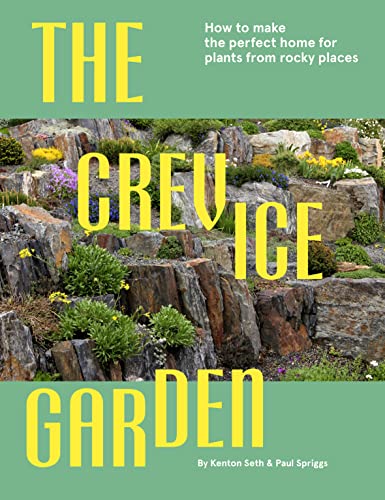
Order The Crevice Garden
It sold through, and it’s reprinted and available again. Order it from Bookshop.org UK, who fund independent bookshops, or see every retailer on the book’s page. Our UK bookshops ship worldwide.
Inside the book
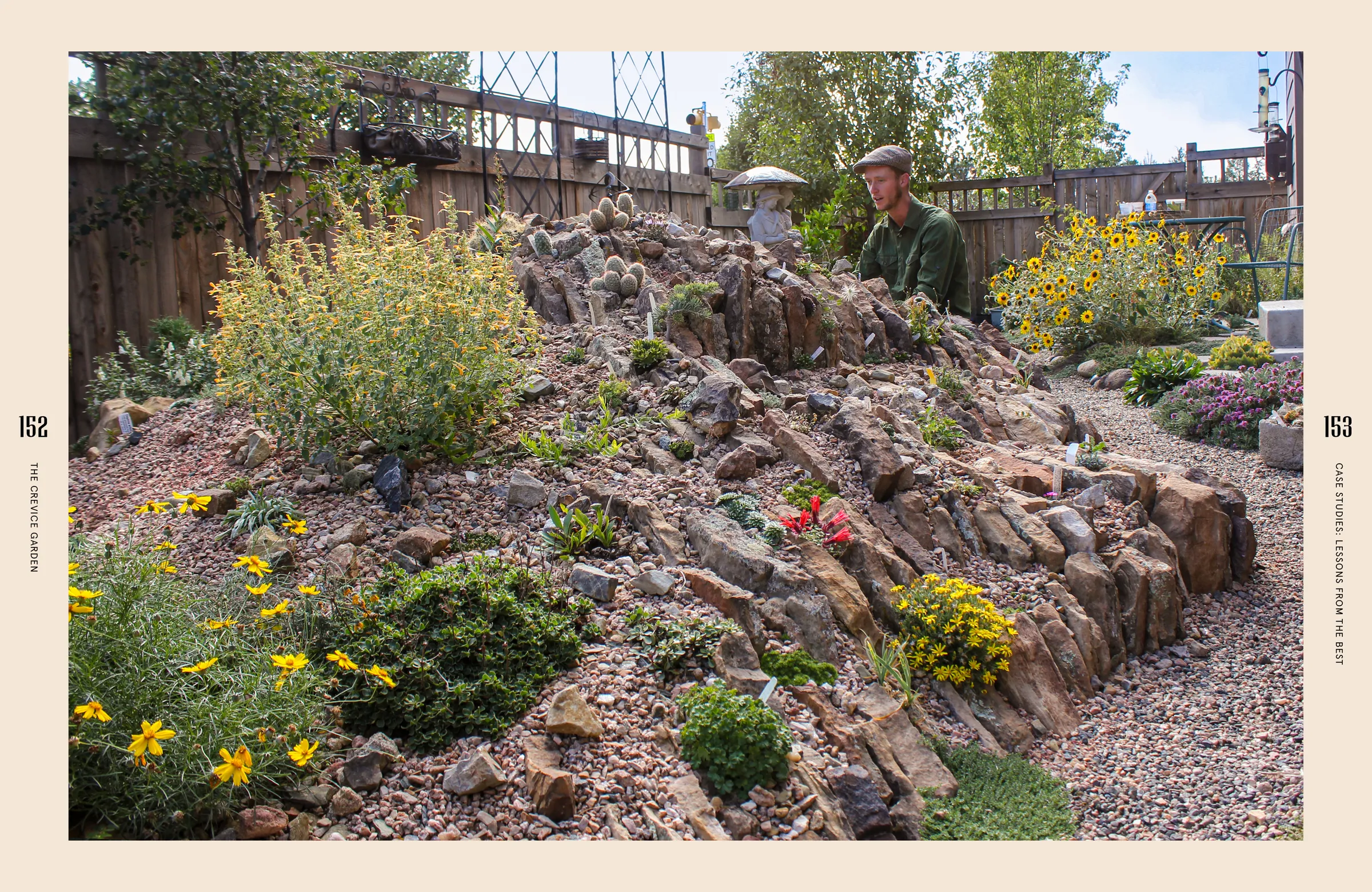
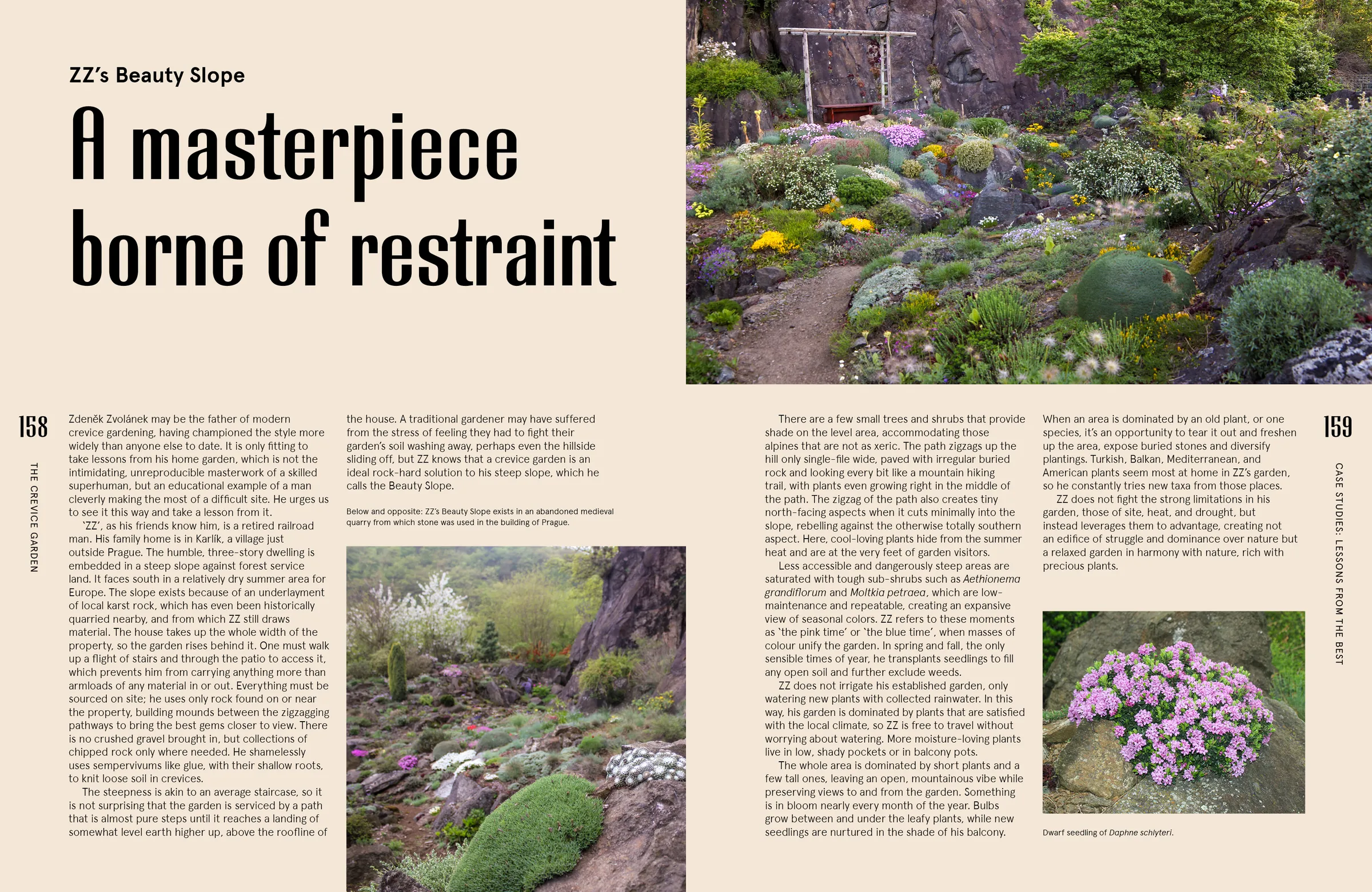
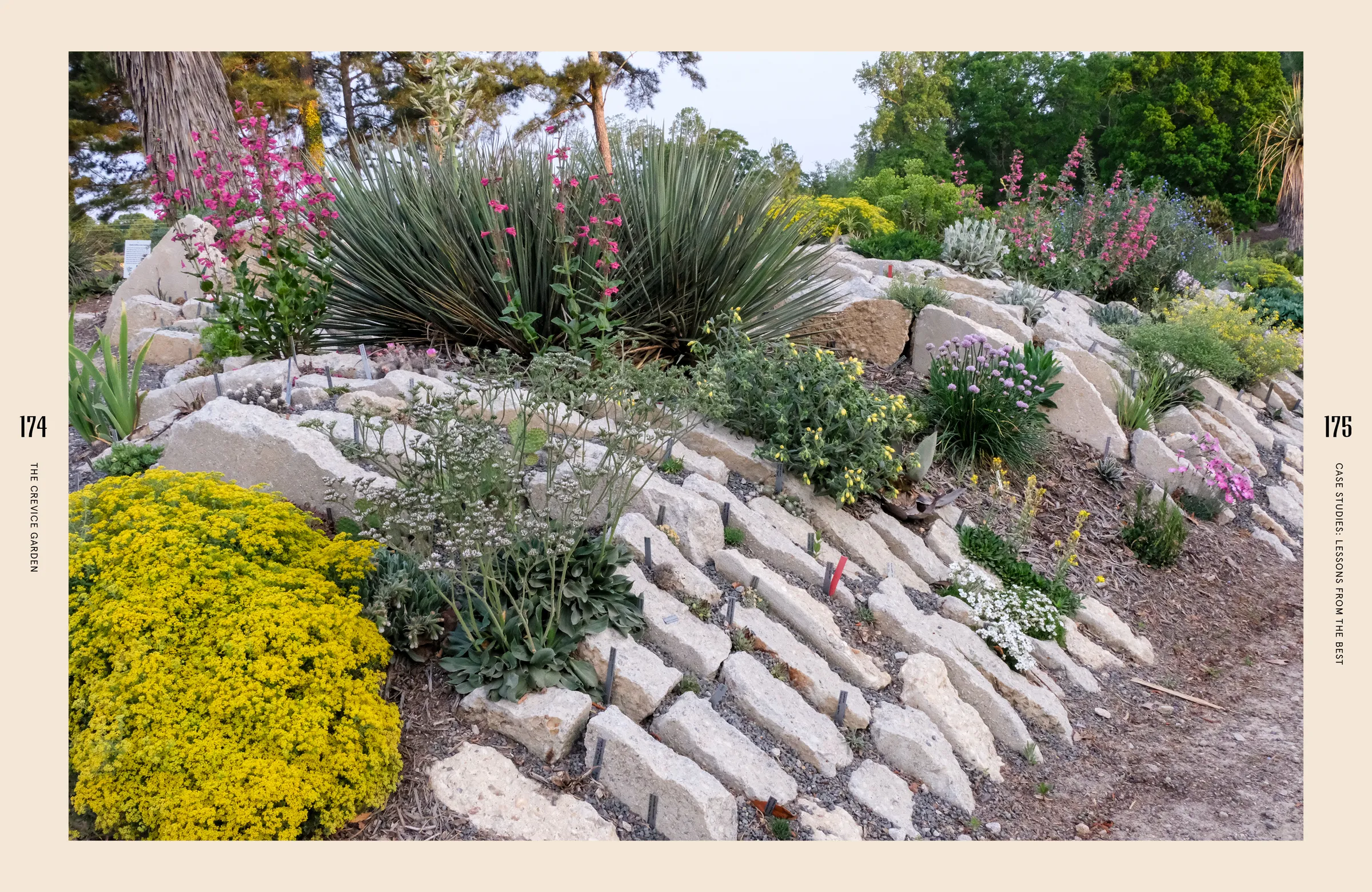
Twelve real crevice gardens, told as case studies — from a Denver back garden to public landscapes and the masterworks of the Czech tradition. A few spreads:
The Crevice Garden
NARGS Book of the Month · North American Rock Garden Society
The complete guide — design, construction, planting and selection — for crevice gardens of every scale, from a patio trough to a public park. 224 pages, with more than 250 recommended plants and the photography that made it an instant classic.
“The Crevice Garden is an instant classic and an essential addition to any rock gardener’s library.” — Joseph Tychonievich, NARGS
See the book →